

Unlocking SiC Performance Through Integrated DC-Link and Power Module Design
Executive Summary
As silicon carbide (SiC) devices continue to gain adoption in EV powertrains and industrial drives, system-level bottlenecks – particularly around switching losses, thermal constraints, and EMI – have shifted from the semiconductor itself to the surrounding passive components. One of the most overlooked yet impactful limitations is the traditional separation between the DC link capacitor and the power module. This whitepaper outlines the rationale, design considerations, and quantified benefits of a co-engineered architecture in which NanoLam™ capacitors are tightly integrated with advanced power modules, forming a single ultra-low-inductance switching platform.
The Case for Integration
The traditional approach treats the DC link as a stand-alone component connected to the module via a busbar or PCB traces. This architecture introduces parasitic inductance in the power loop, which leads to voltage overshoot, EMI emissions, and increased switching losses. These issues, in turn, force conservative gate drive strategies and limit the performance benefits of SiC devices.
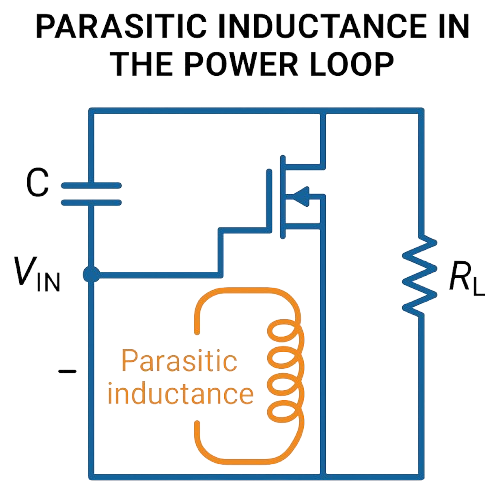
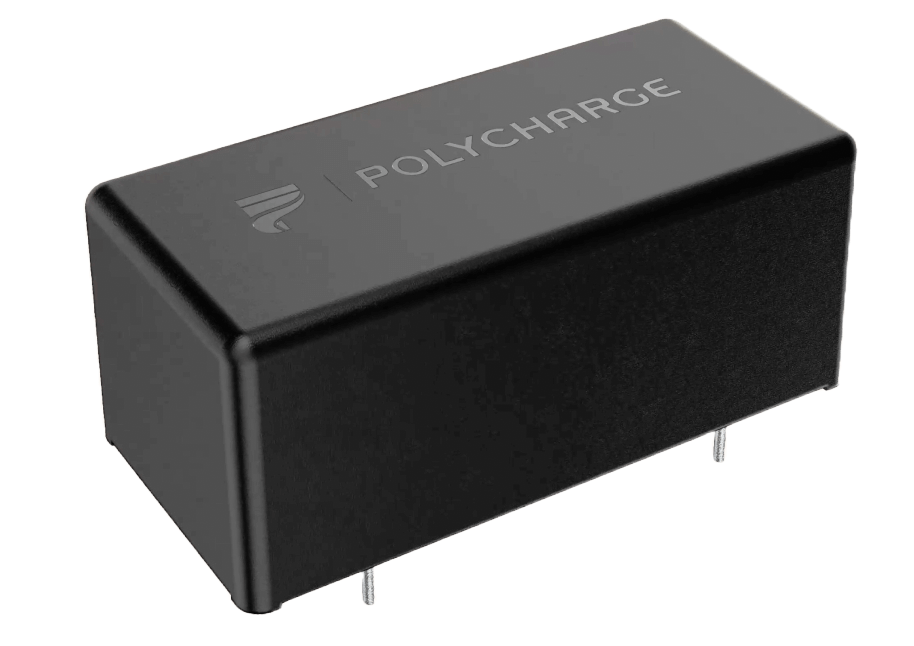
By co-designing the capacitor and module as a unified subsystem, the parasitic inductance can be drastically reduced. NanoLam™ capacitors, with their compact prismatic form factor and high-temperature polymer dielectric, are ideally suited for this purpose. Their ability to handle high ripple currents and fail open (rather than short) further strengthens their suitability for close coupling to SiC devices.

In contrast, conventional polypropylene (PP) film capacitors are physically large, have limited ripple current handling capability, and are constrained by low thermal tolerance (typically 85–105°C). Most critically, the wound structure of PP film introduces high internal inductance, making it fundamentally unsuitable for high-speed switching environments. These characteristics prevent them from being placed close to the switching devices and from withstanding the localized thermal and electrical stress of high-frequency SiC applications. Their size and geometry also introduce unacceptable loop inductance, negating many of the benefits of wide-bandgap semiconductors.
Quantified Benefits
Integrated NanoLam™ DC-link architectures offer a wide range of system-level improvements over conventional capacitor-module pairings.
Switching Loss Reduction
Tightly coupled, low-inductance designs can enable significant reductions in total switching losses—including Etot, Eon, and Eoff—potentially improving efficiency by 30–60%, depending on topology and operating conditions.
Material and Thermal System Efficiencies.
Integration can lead to notable reductions in semiconductor die area, substrate footprint, and cooling system volume—yielding gains in power density, cost structure, and thermal performance.
- System-Level Advantages.
- Reduced voltage overshoot and dv/dt-related stress
- Lower EMI emissions, allowing for smaller and more cost-effective filters
- Enhanced gate drive reliability through minimized transient susceptibility
- More compact and thermally optimized mechanical packaging
Design Considerations
While the benefits are clear, implementation requires cross-functional coordination. Key design elements include:
- Mechanical Co-Design. Matching form factor, mounting, and tolerances
- Thermal Path Optimization. Ensuring both the module and capacitor share a thermal path or are thermally decoupled where appropriate
- Electrical Interfacing. Direct busbar coupling, minimized loop areas, and symmetry
- Reliability Testing. Ensuring stability under load dump, overvoltage, and thermal cycling conditions
Strategic Opportunity
SiC devices are only as good as the system they are embedded in. While advanced power modules and NanoLam™ capacitors each offer compelling advantages on their own, the true performance leap occurs when they are co-designed as a single integrated subsystem. Such collaboration enables:
- Faster time-to-market for highly differentiated inverter platforms
- OEM-level value capture through efficiency and packaging gains
- A differentiated supply chain position versus discrete-component competitors
Enabling the Future – A Multi-Partner Opportunity for System-Level Innovation
To realize the full benefits of a NanoLam™ powered integrated DC-link and power module architecture, a structured, multi-phase collaboration is essential. This effort requires coordinated engagement between PolyCharge, power module manufacturers, and inverter OEMs or system integrators. The process begins with shared alignment on system-level goals, followed by co-design of the electrical, mechanical, and thermal interfaces. Through iterative prototyping and validation, the team evaluates switching losses, EMI, thermal behavior, and reliability. Final integration into inverter systems enables real-world testing, leading into industrialization and supply chain alignment. This collaborative model ensures early design convergence, maximizes SiC performance, and reduces time-to-market while offering significant competitive advantages across performance, packaging, and cost.
Conclusion
The shift to SiC demands a shift in architecture. The integration of NanoLam™ capacitors directly within the power module represents a foundational change in how inverter platforms are conceived and built. But realizing this vision requires more than just technology – it demands collaboration.
About PolyCharge

PolyCharge is a leader in advanced capacitor technologies for demanding power conversion applications across the automotive, aerospace, industrial, and defense sectors. The company's patented NanoLam™ technology enables compact, high-temperature, and high-reliability capacitors designed to meet the performance requirements of wide-bandgap semiconductor systems. With a mission to push the boundaries of energy efficiency and system integration, PolyCharge is redefining how passive components enable next-generation power electronics.
Related posts
PolyCharge Harper & Two
.jpg)
PolyCharge and Globe Capacitors Forge Strategic Partnership to Bring Advanced NanoLam™ Technology to Global Markets
